Billing
The 8-minute rule, explained with the arithmetic
How Medicare's 8-minute rule turns timed minutes into billable units, what changes when you mix timed and untimed codes, and the two mistakes that undercount most therapy claims.
Every therapy practice that bills Medicare knows the 8-minute rule exists. Fewer can do the arithmetic under pressure at 5:40 on a Friday, which is when it gets done. Here is the whole rule in one page.
The rule
For timed CPT® codes (therapeutic exercise, manual therapy, neuromuscular re-education, and so on), add up all the timed minutes in the visit. The total determines how many units you may bill:
| Total timed minutes | Units |
|---|---|
| 8 to 22 | 1 |
| 23 to 37 | 2 |
| 38 to 52 | 3 |
| 53 to 67 | 4 |
| 68 to 82 | 5 |
Each additional 15 minutes adds a unit; the threshold for the next unit is always the previous one plus 15, and the first unit needs at least 8 minutes.
Assigning the units to codes
The units go to the codes with the most minutes first. Suppose a visit had 20 minutes of 97110 and 10 minutes of 97140. Total 30 minutes: two units. 97110 gets one unit (its 20 minutes), and the remaining unit goes to 97140 because its 10 minutes are the next largest block. If the second service had only 5 minutes, you would still have 25 total minutes, still two units, and the second unit would still go to it under CMS’s guidance, because the total minutes justify two units and the remainder is assigned to the service with the most leftover time.
Timed plus untimed
Untimed codes (97161 to 97163, 92507, group codes) are billed once and their minutes stay out of the pool. A 60-minute visit with a 30-minute evaluation and 30 minutes of timed treatment bills the evaluation once plus two timed units, not four.
The two common undercounts
- Rounding at the code level. Counting 12 minutes of one code and 11 of another as zero units each. The rule pools timed minutes first; 23 minutes is two units.
- Losing minutes to documentation. If the note says “45-minute session” but the timed services add to 38, you bill 3 units, not 4. The compliance check that compares session duration with billed minutes exists for exactly this.
The commercial variant
Payers that follow the AMA CPT® convention apply the midpoint rule per code: each timed code needs at least 8 minutes of its own to bill a unit, and the pooling above does not apply. Record which convention each payer uses in its payer rules so the scrubber checks the right one.
How Sefton handles it
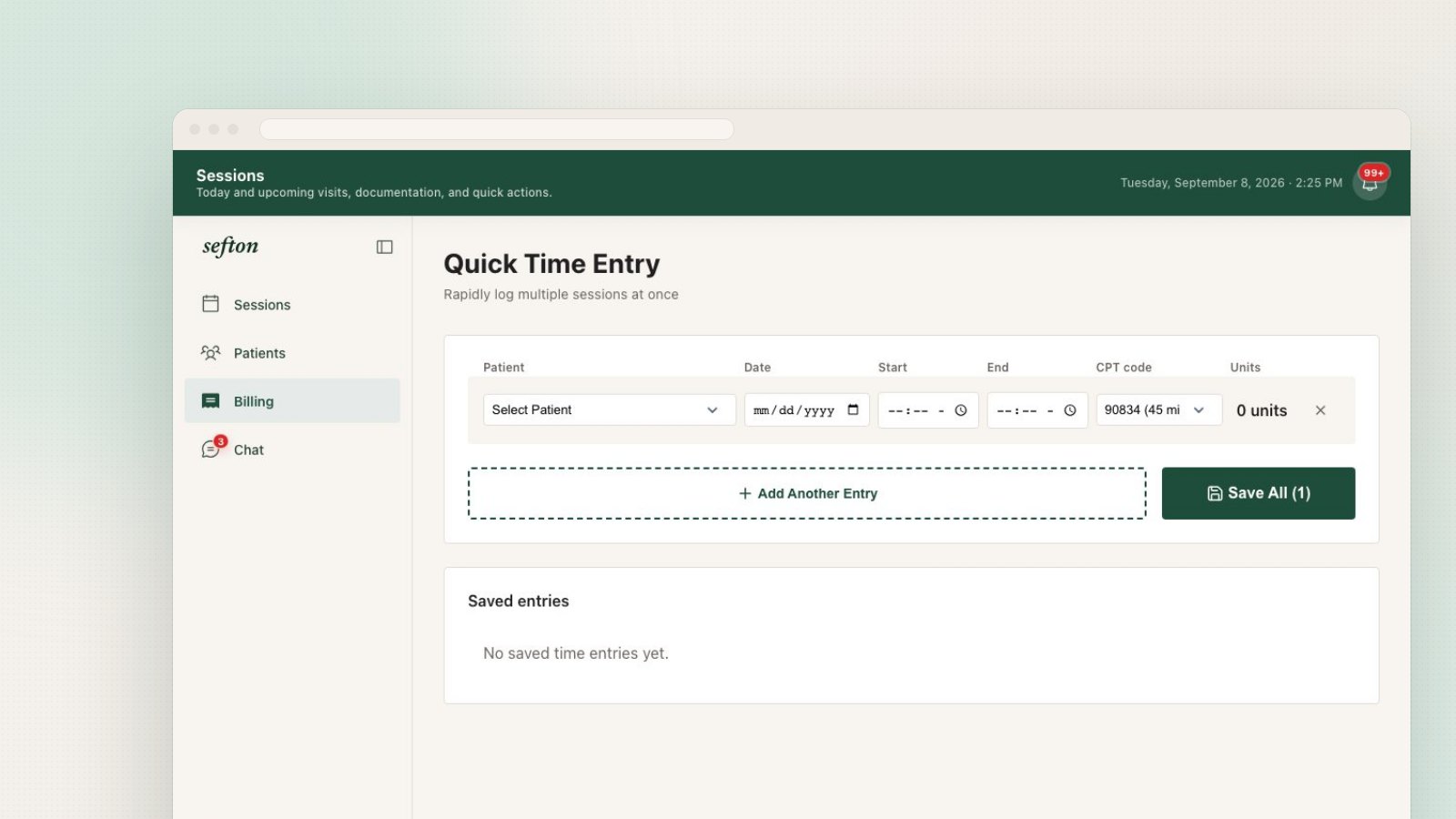
Quick Time Entry takes minutes per code and shows the unit count as you type, using the rule configured for the payer. The Time Match Verification check compares documented duration with billed units before the claim leaves. Nothing is billed until you confirm the codes.
Related: Time tracking and Quick Time Entry, Documentation completeness and compliance checks.
Frequently asked questions
Does the 8-minute rule apply to commercial payers?
Medicare and Medicaid programs that follow CMS use it. Many commercial payers use the AMA's per-code rule instead, where each code needs at least 8 minutes on its own. Check the payer's policy and set it in the payer's rules.
Do untimed codes count toward the total minutes?
No. Untimed codes (an evaluation, for example) are billed once regardless of duration and their minutes are not pooled with timed codes.